
Methodology
The Scenario Compass offers a suite of features that make it easier to draw reliable insights from scenario sets.
Learn about how scenarios are quality-controlled and assessed in terms of sustainability and feasibility.
How are scenarios quality-controlled?
Scenarios are evaluated against historical data along key dimensions of energy consumption and emissions. The quality criteria were developed by the Scenario Compass Initiative (SCI) [scientific working groups] {The Scenario Compass Initiative} and were subject to a public review process. Scenarios that fail historical data checks are hidden by default but can be shown in the visualizations. Please see a screenshot below:
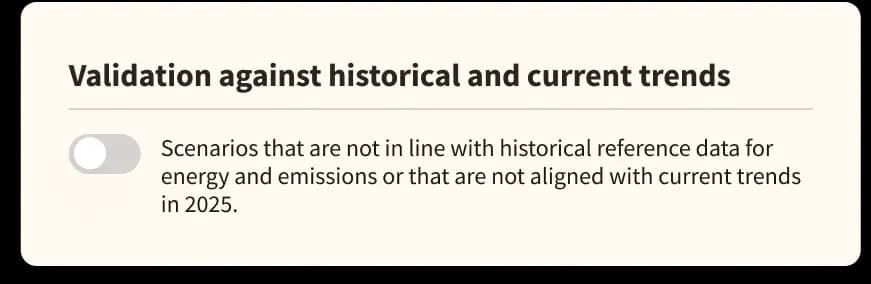
More information on vetting criteria can be found here.
How do sustainability and feasibility criteria (“flags”) communicate expert assessments?
Based on expert assessments conducted by the SCI's scientific working groups scenarios are marked with “flags” to indicate reasons for concern if they exceed feasibility or sustainability thresholds. These flags are marked as “medium” or “high” to indicate the severity of the concern.
How to interpret a set of scenarios?
Scenarios in the Scenario Compass come from a variety of published studies — an "ensemble of opportunity” of what is available, not a representative exploration of all possible futures. This means you cannot infer probabilities from their number or frequency. The Scenario Compass should be used primarily to understand the implications of different assumptions about the future.
New tools will be released later this year
SCI is developing a range of methodological tools that will facilitate the interpretation of scenario data. These will be introduced in the coming months.
Scenario Dashboard
Browse and filter scenarios based on your interests.